After Graduation
Explore career paths related to your Human Ecology major and find resources to help you plan your next steps after graduation.
What can I do with my major?
Your Human Ecology major provides you with a highly specific, in-demand skill set, whether in fundraising & development, interior design, or consumer analytics. If you’re wondering how your major might translate into a career, we’ve already mapped some ideas out for you. Pick your major below to explore common career paths, top employers, and industry trends:
Chart your own path
Ready to turn that degree into a paycheck? Let’s get your resume out of the drafts and into the right hands.
Applying for jobs can feel like a full-time job in itself. The good news? You already have the skills; now it’s just about learning how to market them. We’re here to help you cut through the noise of online job boards and build a strategy that actually works.
- Nail the first impression: Get your resume and cover letter past the automated filters and into the hands of real human recruiters. It’s all about Creating a Tailored Application Package which we cover in depth in our Career Guide.
- Tap the network: Did you know most jobs are found through networking? Learn how to leverage our massive alumni network on LinkedIn (without feeling awkward about it).
- Prep for the interview: From answering behavioral interview questions to professional follow-up. Find it all in Your Guide to a Successful Interview.
Ready to start looking? Check out our Search for Jobs page for additional tips for a successful search, along with links to popular job sites and curated roles tailored to Human Ecology majors! Find more Job Search Resources in the Career Guide.
Not done learning? Whether it’s a Master’s, PhD, or professional school, continuing your education is a massive investment in your future. But between entrance exams, personal statements, and securing letters of recommendation, the application process requires some serious project management.
- Is it the right time? We’ll help you weigh the Return on Investment (ROI) of going straight to grad school versus working for a few years first.
- The application timeline: Work backward from your application deadlines to create a stress-free schedule for studying for exams (GRE, LSAT, MCAT) and writing essays.
- Crafting your narrative: Your personal statement needs to be more than just a recycled resume. Draft a story that admissions committees will remember.
We cover the whole process in depth in the School of Human Ecology Graduate School Guide.
Check out the links below to begin your search for the right graduate program.
Stepping away from school and work for a bit? Sometimes the best next step is taking a beat to figure things out while making a tangible impact. UW–Madison continually ranks as one of the top schools in the nation for students who volunteer with service organizations after graduation. Taking a year of service isn’t about “falling behind”—it’s an incredible way to develop hands-on skills while working with and serving a wide variety of communities.
Stepping away from school and work for a bit? Sometimes the best next step is taking a beat to figure things out while making a tangible impact. UW–Madison continually ranks as one of the top schools in the nation for students who volunteer with service organizations after graduation. Taking a year of service isn’t about “falling behind”—it’s an incredible way to develop hands-on skills while working with and serving a wide variety of communities.
- Explore the possibilities: There are tons of ways to get involved. Start by checking out these popular service organizations Human Ecology students have volunteered with in the past:
- Find your fit: Not all programs are created equal. Before committing, check out these Service/Gap Year Considerations to help you vet opportunities and ensure the program aligns with your personal values and career goals.
- Translate your experience: A year of service builds intense adaptability, leadership, and cross-cultural communication skills. When you’re ready, we’ll show you how to frame this on your resume so employers see the massive value you bring to the table after your volunteer experience.
2024-25 First Destination Survey Results*
*based on a 74% knowledge rate
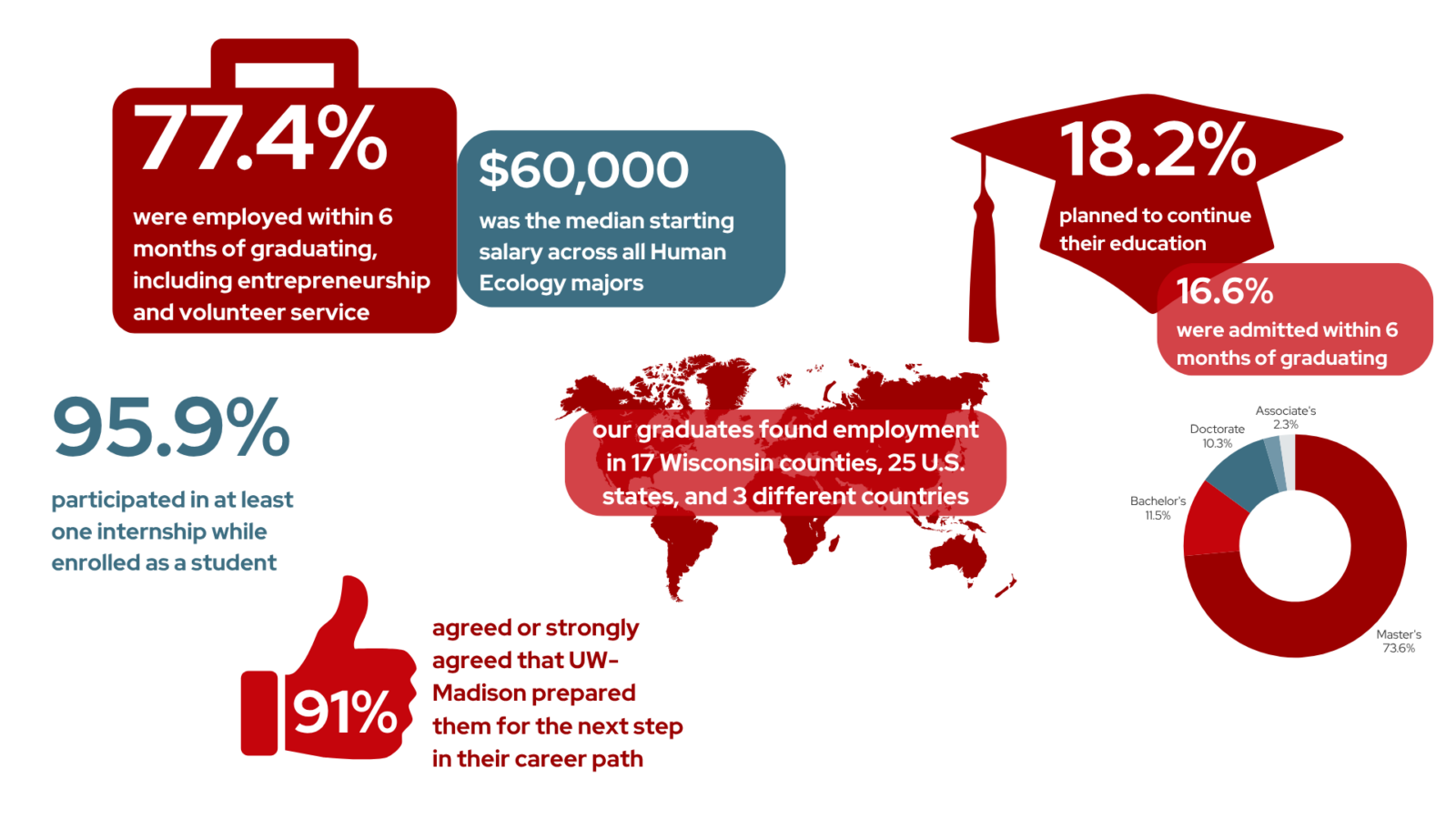
Results from the 2024-25 campus-wide First Destination Survey, which is administered to students at the time of graduation, show that based on a 74% knowledge rate:
- 95.6% of Human Ecology graduates had positive outcomes, which include full- or part-time employment, entrepreneurship, volunteering/service, or continuing education.
- Only 3.8% of Human Ecology students were still seeking within six months of graduation.
- Of graduates from the Class of 2025 we have known outcomes for, 77.4% were employed, including entrepreneurship and volunteer service.
- The median starting salary across all Human Ecology majors was $60,000.
- 18.2% planned to continue their education, with 16.6% having already been admitted within six months of graduating. For those continuing their education:
- 73.6% are pursuing a Master’s degree
- 11.5% an additional Bachelor’s degree
- 10.3% a Doctorate
- 2.3% an Associate’s degree
- 2.3% a Certificate
- Human Ecology graduates were employed in 25 different U.S. states, 17 Wisconsin counties, and 3 countries.
- 95.9% completed at least one internship while enrolled as a student.
- 91% of Human Ecology graduates who responded to the survey agreed or strongly agreed that UW–Madison prepared them for the next step in their career path.
Where are they now?
Career Pathways of Human Ecology Graduates
This interactive map highlights the wide range of careers our Human Ecology alumni have reported on the First Destination Survey administered at the time of graduation for those graduating between Fall 2019–Fall 2024, along with the SoHE Alumni Career Development Survey, administered to alumni 1–3 years post-graduation in 2019 and 2022.
To explore the wide range of career pathways by major, expand the map using the icon in the upper right-hand corner and apply the available filters.
Map symbol key: Personal Finance
 Interior Architecture
 Human Development & Family Studies
 Consumer Behavior & Marketplace Studies
 Community & Organizational Development
 Textiles & Fashion Design
 Design, Innovation, & Society
View a Google Sheet of these experiences.
Visit wisc.joinhandshake.com to explore additional jobs in your desired field!
Continuing Education Pathways of Human Ecology Graduates
This interactive map highlights the diverse graduate and professional programs our students and alumni have attended around the world, featuring data drawn from the First Destination Survey administered at the time of graduation for those graduating between Spring 2020–Fall 2024, along with the SoHE Alumni Career Development Survey, administered to alumni 1–3 years post-graduation in 2019 and 2022.
To explore the wide range of continuing education pathways by major, expand the map using the icon in the upper right-hand corner and apply the available filters.
Ready to take the next step? We are here to help!
Every career journey is different, and fine-tuning your application materials and interviewing skills takes practice. Whether you want a second set of eyes on your resume, help tailoring a cover letter for a dream role, or a live mock interview to polish your STAR stories, the Advising & Career Center is here to support you every step of the way.